Future Directions
& Regenerative Tourism
From smarter systems to places that give back more than they take.
Speaker notes · 0:00–0:45 · 15-minute box
Opening (0:00-0:45). Introduce ourselves and the topic. Say the presentation has three moves: what is new, what the evidence shows, and what we should be sceptical about. Tell the class there will be a short quiz and a discussion, so they should be ready to participate. Total time box: 15 minutes. If several topics are presented on the same day the brief caps us at 10 minutes: cut slides 5, 9 and 14 and shorten the discussion to one question.
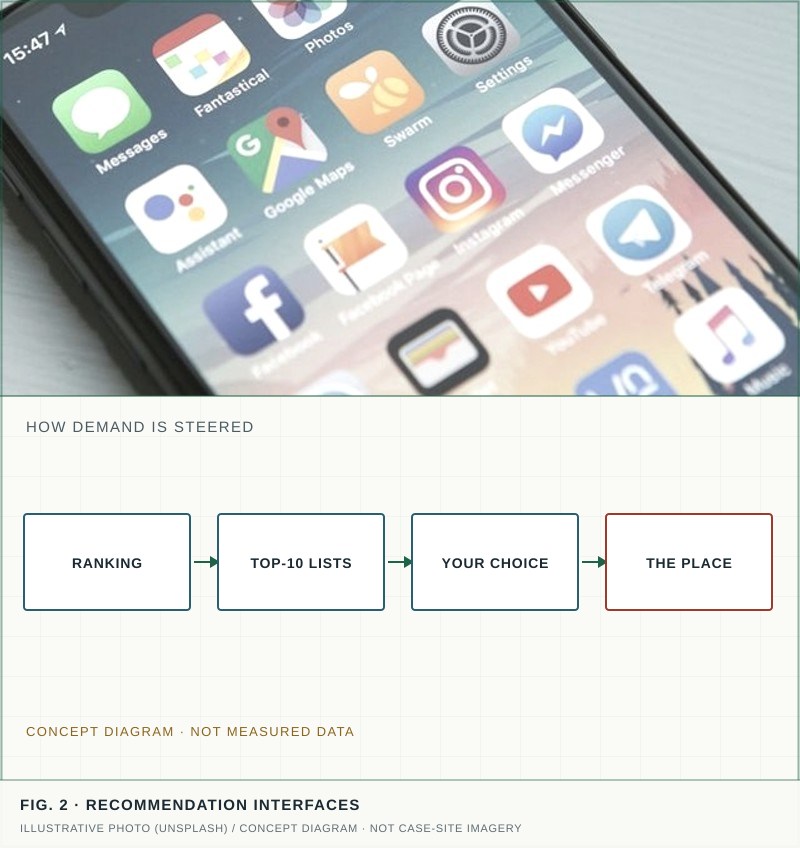
Your phone already decided where you will eat tonight.
A recommendation, a rating, a "top 10" list — and a neighbourhood that was never asked.
Hold that thought. We return to all three at the end — and we want your answers, not ours.
Speaker notes
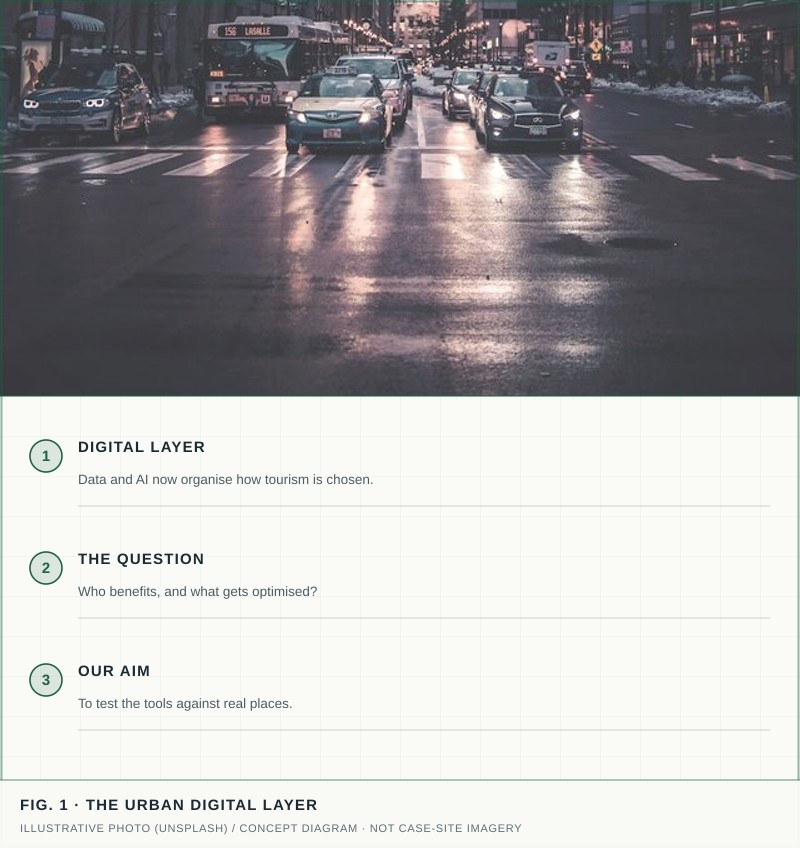
Hook (0:45-1:30). Do not answer the questions yet. Ask for a quick show of hands on question 1 to warm up the room. This is deliberate: the CooSpace brief asks us to generate a discussion and active participation counts for 50% of the grade.
Three shifts, one argument
What is genuinely new — and what we will test against real cases.
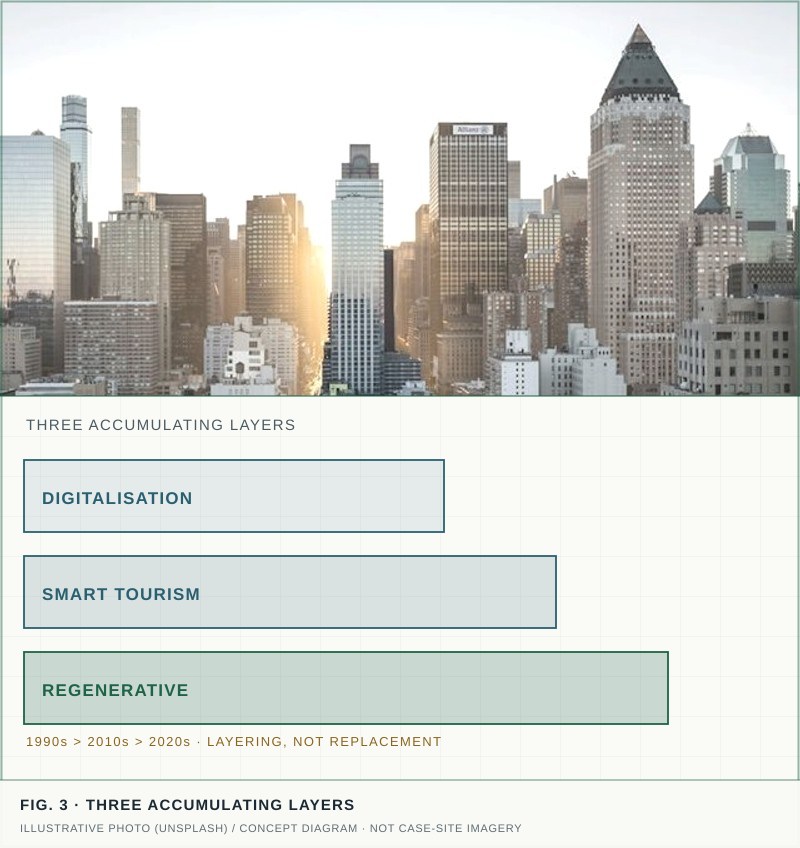
DIGITALISATION
The infrastructure layer. Data, AI and platforms become the medium through which tourism is organised.
data · AI · platformsSMART TOURISM
The optimisation layer. Real-time sensing and routing promise to make destinations run more smoothly.
sensors · real-time · flowsREGENERATIVE
The purpose layer. The goal shifts from reducing harm to actively rebuilding a place's capacity.
community · capacity · net gainOUR CLAIM. Tools are neutral — outcomes depend on who controls them and what they optimise for.
Speaker notes
Roadmap (1:30-2:15). Frame the three layers. Emphasise that we will not simply celebrate technology. State the thesis clearly — it is the thread running through all 17 slides.
What does the topic mean for you?
The brief asks us directly — so here are two honest answers, not a textbook definition.
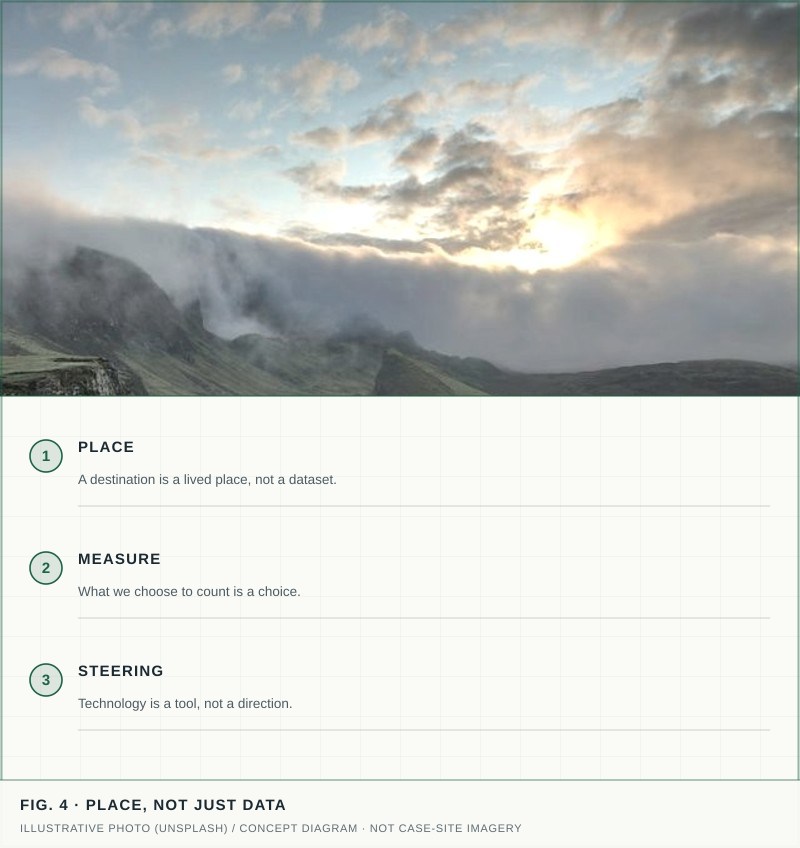
FAN JIAPENG IN MY WORDS
To me, "future directions" is really a question of steering. Technology gives us a much faster car; regenerative tourism asks where we should actually drive — and who gets to hold the wheel.
Steering, not speed.QIAO YIRAN IN MY WORDS
For me it is the gap between a dashboard and a place. A smart city can count every visitor and still miss whether the neighbourhood is thriving. I want to know what we choose to measure.
Measurement is a choice.TOGETHER. The future is not more technology — it is better questions asked of it.
Speaker notes
Personal question (2:15-3:00). This slide answers the CooSpace requirement "What does the topic mean for you?" explicitly. Each of us speaks to our own card — split the delivery, roughly 20 seconds each. Keep it personal and concrete.
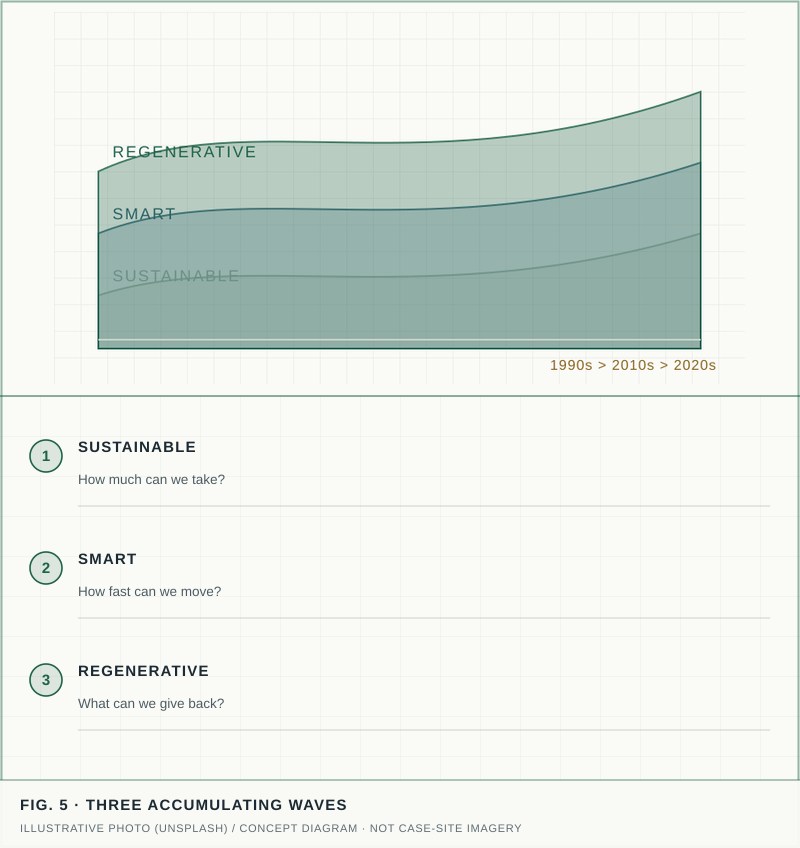
From doing less harm to leaving it better
Three waves of thinking — each one adds a layer, none replaces the previous one.
SUSTAINABLE
1990s →
The question it asks: How much can we take?
Minimise damage · footprint · carrying capacity
SMART
2010s →
The question it asks: How fast can we move?
Optimise flows · data · real-time decisions
REGENERATIVE
2020s →
The question it asks: What can we give back?
Restore capacity · community · net positive
Crucially, a regenerative destination still needs the sustainability floor and the smart data layer underneath it.
Speaker notes
Framing (3:00-3:45). Explain the chronology briefly. The key point is layering, not replacement — this matters later when we argue that smart tools alone are not regenerative. Ask rhetorically which wave most destinations are actually operating in.
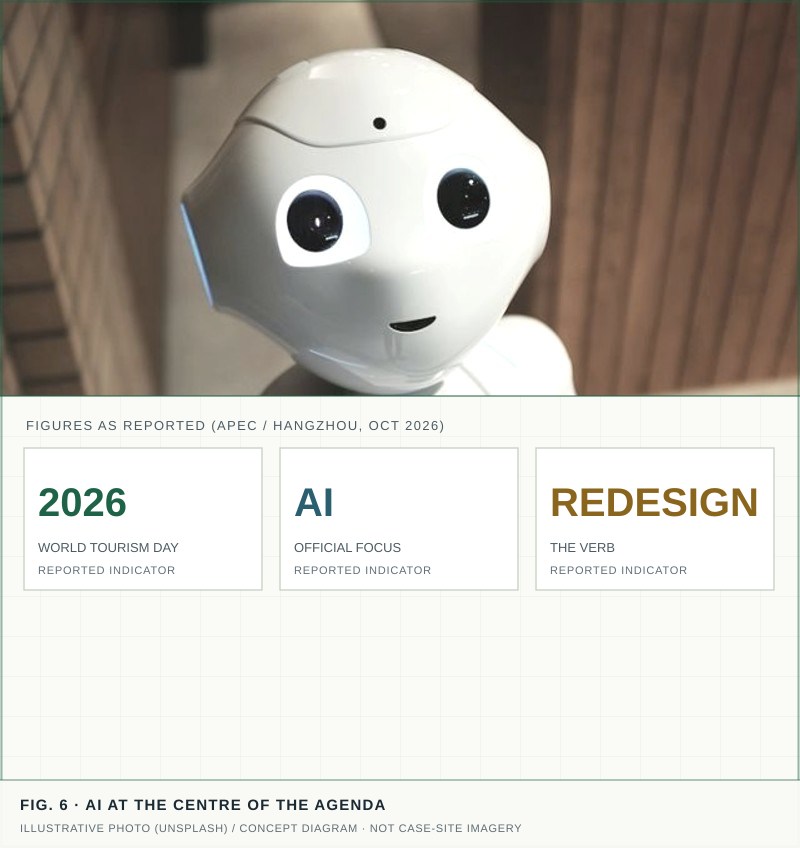
The UN has put AI at the centre of tourism's agenda
"Digital Agenda and Artificial Intelligence to Redesign Tourism"
UN World Tourism Day 2026 · Official themeRedesign, not just digitise
The wording moves from scanning tickets to re-writing how value and visibility are distributed.
AI as an allocator
Recommendation systems increasingly decide which places — and which platforms — receive demand.
A warning in the same breath
"Yet left unchecked, it can funnel tourists to the same few places and platforms…" — A. Guterres. The newest official framing already contains its own critique.
Source: UN Tourism, World Tourism Day 2026 official theme; message of the UN Secretary-General.
Speaker notes
Novelty 1 (3:45-4:45). This is the newest official issue: the 2026 World Tourism Day theme. Read the theme aloud. The Secretary-General's warning is important — we return to it as our bad example on slide 11. Do not present AI as neutral infrastructure.
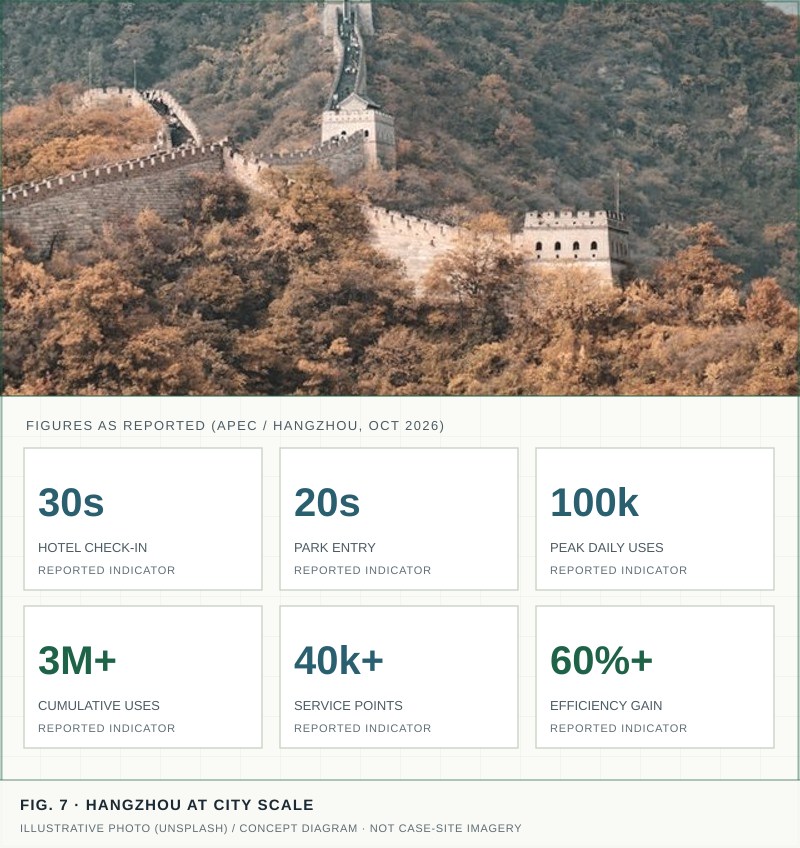
Hangzhou shows what "smart" looks like at city scale
APEC Smart Tourism Seminar, Hangzhou, 28–30 October 2026 · theme: "AI-era tourism services"
Source: figures reported around the APEC Smart Tourism Seminar / Hangzhou municipal smart-tourism reporting, Oct 2026.
Speaker notes
Novelty 2 (4:45-5:45). Give the numbers quickly, do not read every one. The punchline is the amber bar: these are throughput metrics. Ask the room what a "healthier destination" metric would even look like — this seeds slide 13 on measurement. Note that these figures are as reported around the APEC seminar; be transparent about the source rather than over-claiming.
Regeneration changes the unit of success
The same destination, judged by a different question.
| SUSTAINABLE | REGENERATIVE |
|---|---|
| Reduce negative impact | Create net positive capacity |
| Carrying capacity as a ceiling | Capacity as something to rebuild |
| Visitors as consumers | Visitors as temporary stewards |
| Measure the footprint | Measure ecological and social return |
| Destination managed for tourists | Destination shaped with residents |
| "Do less harm" | "Leave it better" |
Working definition: tourism that leaves a place with more ecological, cultural and economic capacity than it had before.
Speaker notes
Novelty 3 (5:45-6:30). Walk down two or three rows only. The important conceptual move is from a ceiling (how much can we take) to a balance sheet (did we give back more than we took). Flag that "net positive" is hard to prove — that becomes the critical lens on slide 12.
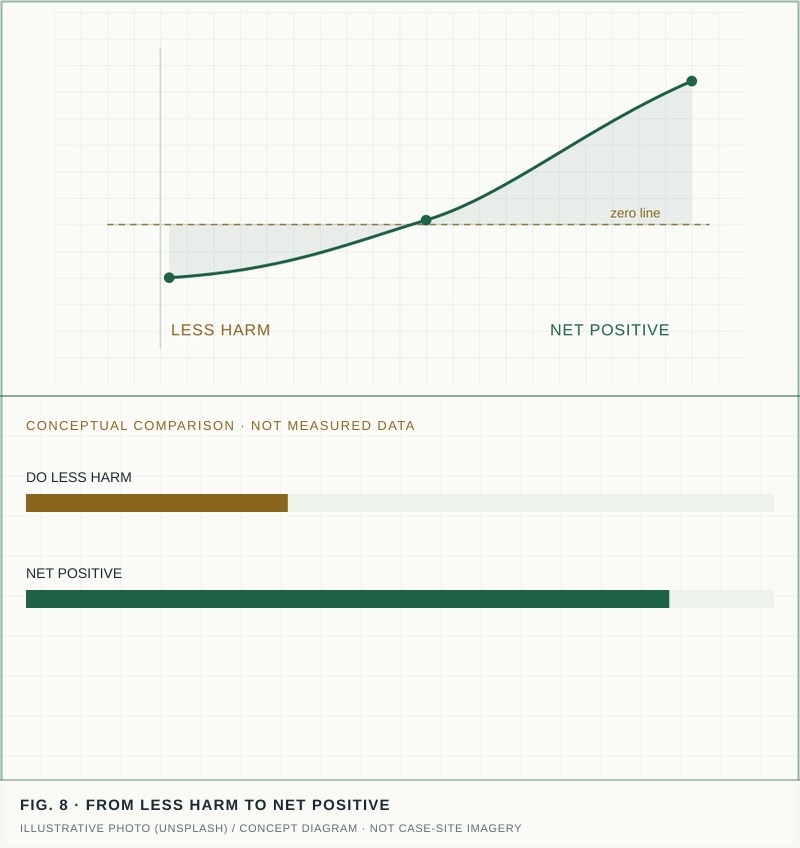
Hangzhou: using data to disperse, not just accelerate
The mechanism · one chain, four links
Why it works
Efficiency is a means, not the KPI
A 30-second check-in frees staff for service, not merely throughput.
Destination scale, not single-site
City-wide mapping lets flows be spread across many places at once.
Coordination in shared hands
A city-level platform can steer demand across sites, not only inside one attraction.
Source: APEC Smart Tourism Seminar, Hangzhou, Oct 2026; Hangzhou smart-tourism reporting.
Speaker notes
Good example 1 (6:30-7:30). This is our first of three main examples. Present the mechanism as a chain, then the three reasons. Importantly, end on the amber caveat — we are not uncritical fans. This shows the critical thinking the brief asks for.
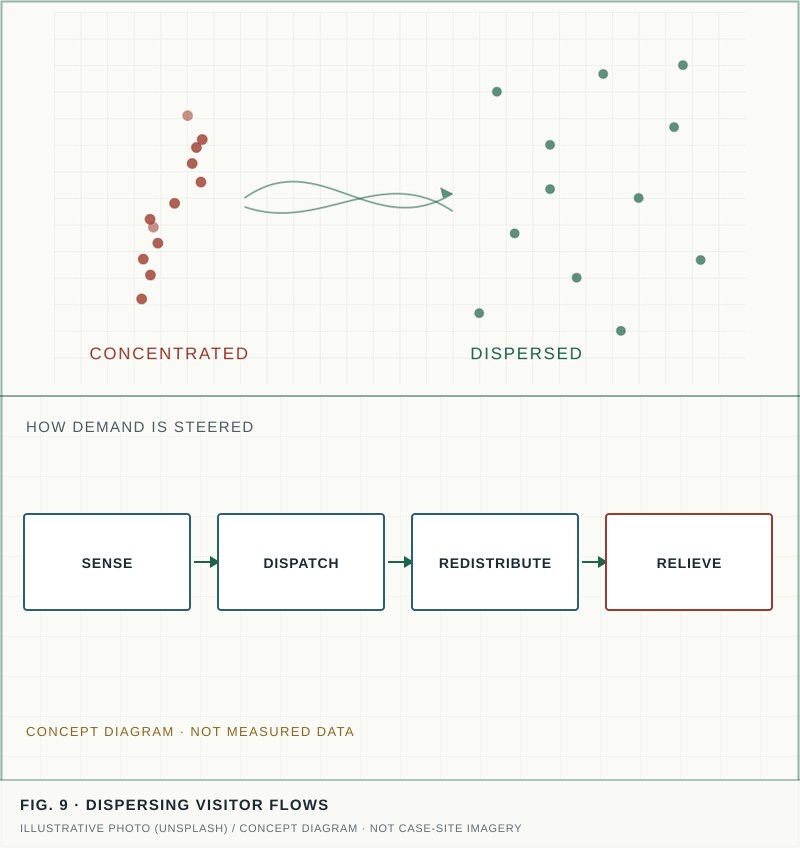
New Zealand: Tiaki Promise and kaitiakitanga
THE PLEDGE · Tiaki Promise
1. Care for land, sea and nature, treading lightly and leaving no trace.
2. Travel safely, showing care and consideration for all.
3. Respect culture, travelling with an open heart and mind.
THE IDEA · kaitiakitanga
Tiaki means to care for people, place and culture. Kaitiakitanga is the Māori practice of guardianship — protecting a place for future generations, not consuming it.
A national pledge asking every visitor to care for land, sea and culture — and to travel safely and respectfully.
WHY THIS IS REGENERATIVE: it asks every visitor to act as a guardian — a role, not a transaction.
Source: Tiaki Promise (tiakinewzealand.com); concept of kaitiakitanga, Māori guardianship.
Speaker notes
Good example 2 (7:30-8:20). Contrast deliberately with Hangzhou: this example has almost no technology in it, yet it is more clearly regenerative. That contrast is the point. Pronounce kaitiakitanga carefully; explain it respectfully as a Māori concept of guardianship. The three pledges on the right are quoted verbatim from tiakinewzealand.com — read them as written.
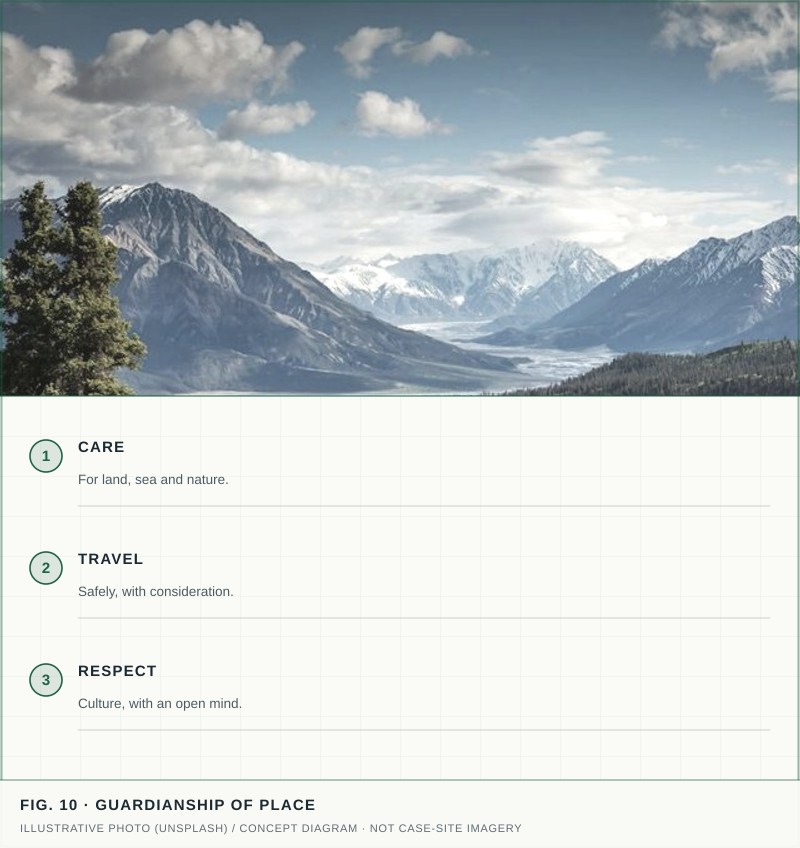
When "smart" funnels everyone to the same few places
"Yet left unchecked, it can funnel tourists to the same few places and platforms, leaving many worthwhile destinations behind."
— António Guterres, UN Secretary-General, World Tourism Day 2026 messageSource: António Guterres, UN Secretary-General, World Tourism Day 2026 message; UN Tourism.
Speaker notes
Bad example (8:20-9:20). This is our third main example and the direct counterweight to slide 6. Use the chain left to right. Point out that the failure is not a bug — it is what happens when the objective function is engagement. Ask who in the room has been sent to the same "hidden gem" as everyone else.
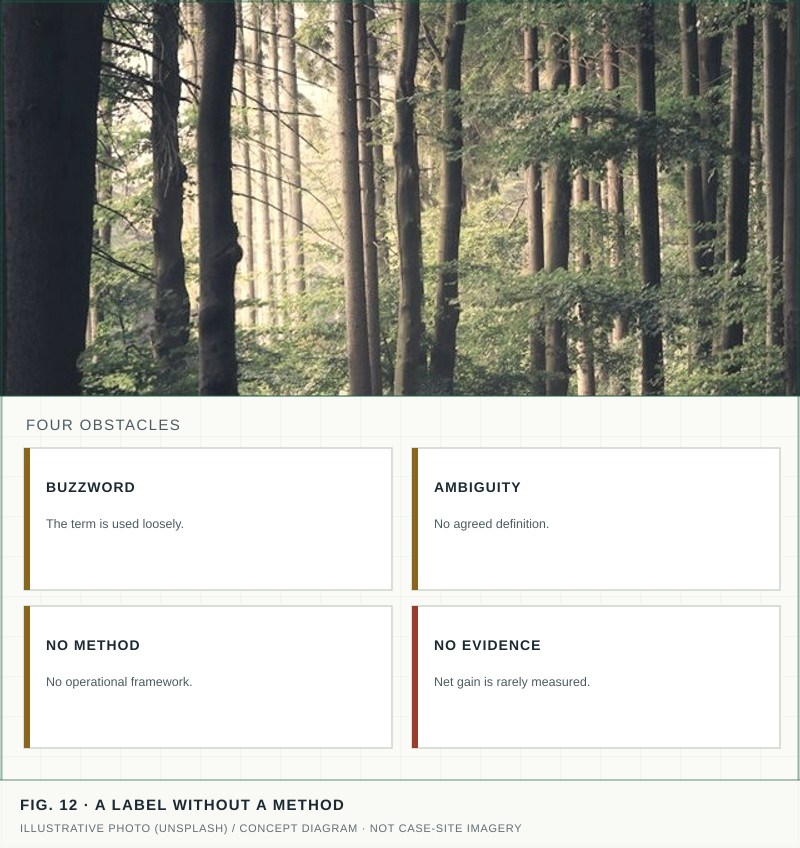
"Regenerative" is a label, not yet a method
GSTC's caution
buzzword · ambiguity · lacks a coherent operational framework
Without a definition and measurable criteria, the word can be attached to almost any product — including ones that change nothing.
Three red flags
1 · No baseline — nothing was measured before the claim was made.
2 · No community voice — regeneration decided in a brochure, not with residents.
3 · No net-gain evidence — only offset-style gestures, with no audited outcome.
If everything is regenerative, is anything?
Source: GSTC (Global Sustainable Tourism Council) commentary on regenerative tourism.
Speaker notes
Critical lens (9:20-10:10). This is where we are most sceptical of our own topic. GSTC's caution is a legitimate academic critique — cite it as such. The closing question is deliberately uncomfortable: we are students presenting on "regenerative tourism" and we should admit the term is not yet operationally settled.
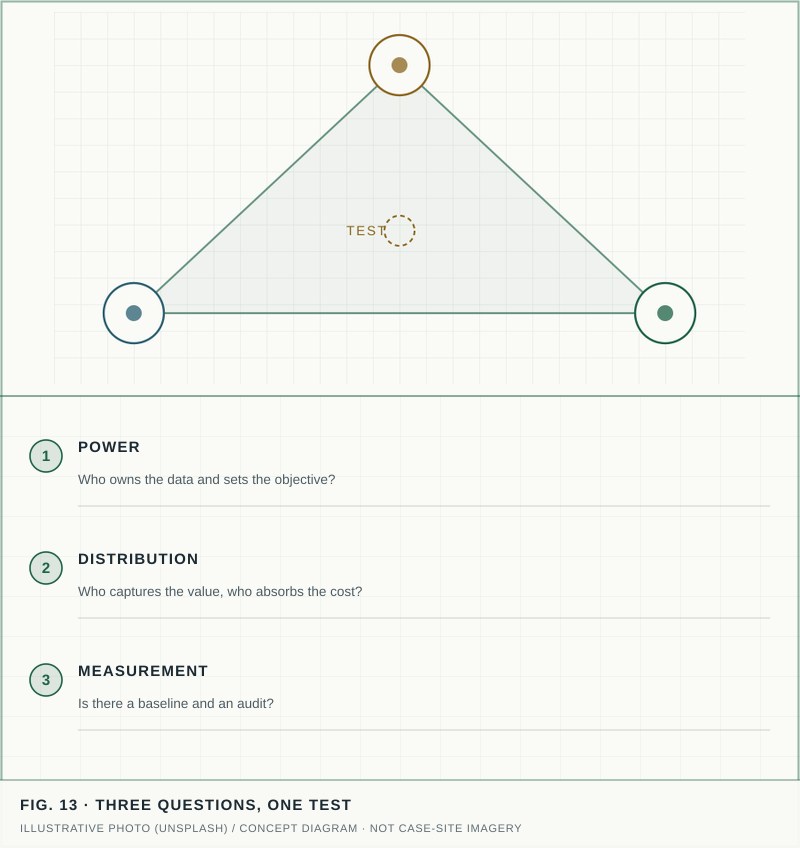
Three questions to ask of every "future" claim
POWER
Who owns the data and sets the objective?
Who can switch the system off — and who cannot?
DISTRIBUTION
Who captures the value, who absorbs the cost?
Does the gain reach residents, or only intermediaries?
MEASUREMENT
What would count as proof of net gain?
Is there a baseline, an indicator and an audit?
Our working rule: a technology story without an answer to these three is a marketing story.
Speaker notes
Critical thinking (10:10-11:00). Offer this as a reusable checklist for the class, not just for our topic. Invite them to apply it to the Hangzhou case: power and distribution are largely unanswered there, measurement is a throughput metric only.
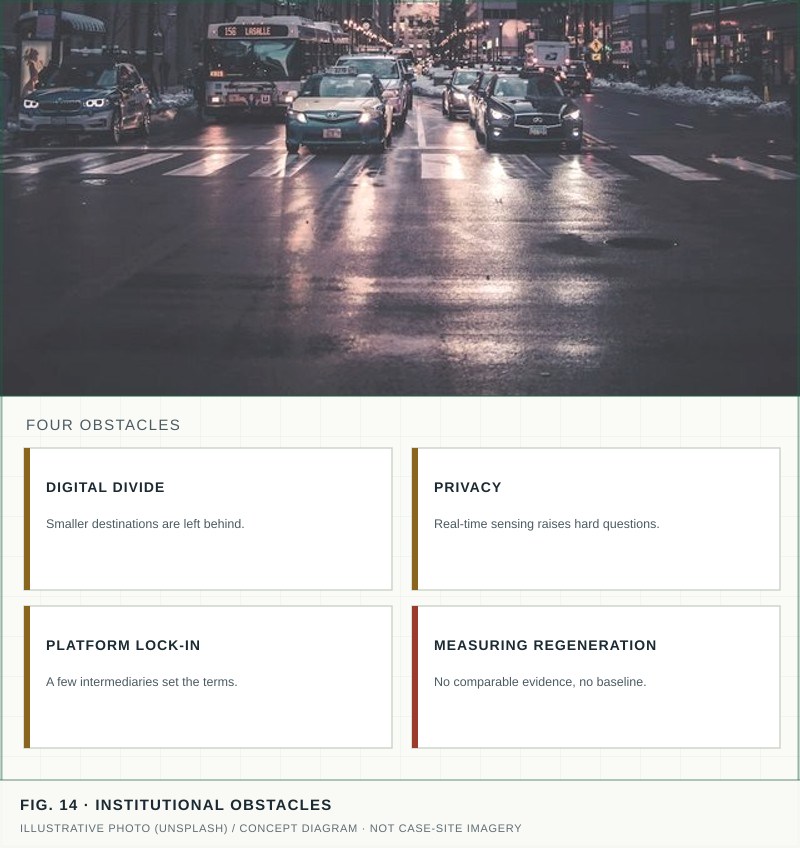
Four things still standing in the way
The obstacles are institutional and political at least as much as they are technical.
DIGITAL DIVIDE
SMEs and rural destinations cannot afford the data infrastructure that "smart" quietly assumes.
PRIVACY & SURVEILLANCE
Real-time flows mean real-time tracking; consent rarely scales as fast as sensors do.
PLATFORM LOCK-IN
Once demand depends on a few intermediaries, destinations lose their bargaining power.
MEASURING REGENERATION
No agreed baseline, no agreed indicator, no comparable evidence across places.
The hardest is the fourth: you cannot manage what you cannot define.
Speaker notes
Challenges (11:00-11:50). These are the "challenges" the brief asks for. Keep it brisk — one sentence each. The fourth links back to the GSTC critique and forward to the discussion, so linger on it for a few seconds.
Smart, regenerative, or neither?
Three short calls. Hands up, or shout it out — no wrong feelings, only interesting reasons.
Select an answer to reveal our call. Answers stay hidden during the live talk — see the speaker notes.
We will take answers live before the discussion — and explain our own calls in the Q&A.
Speaker notes
Quiz (11:50-12:40). The brief explicitly suggests quizzes. Take answers by show of hands for each; ask one person to justify a choice. Our calls: Q1 = A (it optimises flows; no evidence of net gain). Q2 = B (baseline + community decision + measured outcome). Q3 = C (regenerative washing — see slide 12). Do not reveal the answers until the Q&A so the discussion stays open.

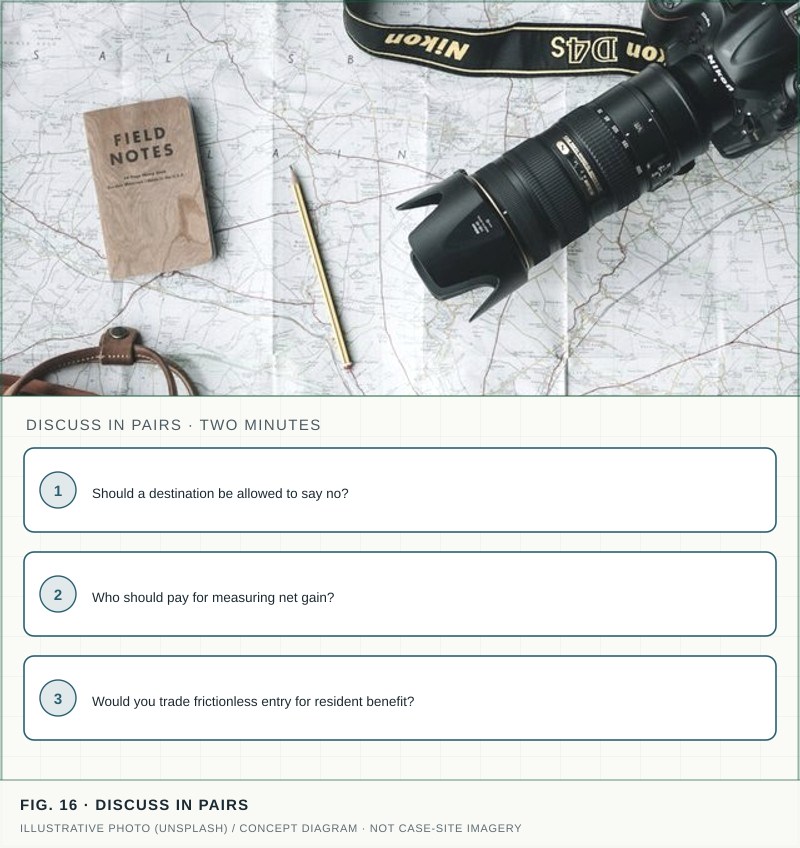
Over to you
Pick one question, discuss in pairs for two minutes, then tell us what you decided.
We will collect your answers and fold them into the Q&A — this is the part we most want from you.
Speaker notes
Discussion (12:40-14:00). This directly satisfies "Generate a discussion with your presentation!". Give the room two full minutes of pair discussion, then take 2-3 responses. Active participation is 50% of the course grade, so do not rush this. If the room is quiet, start with question 3 — it is the most personal and gets people talking.
Back to the phone
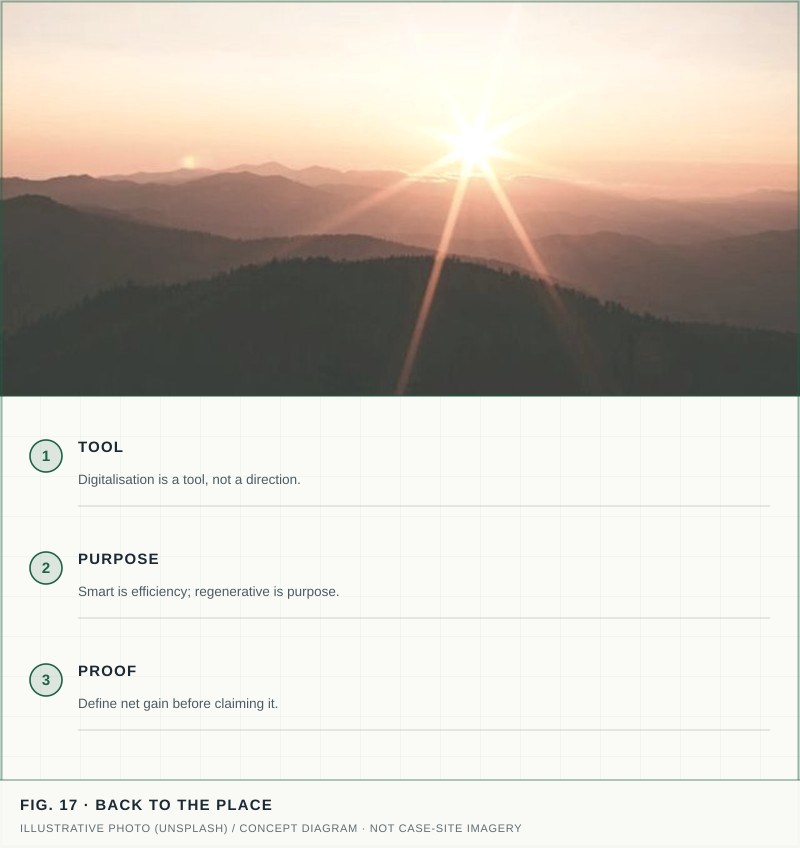
Your phone may still decide where you eat. The real question is who taught it to care about the place.
- Digitalisation is a tool, not a direction.
- Smart is about efficiency; regenerative is about purpose.
- If we cannot define and measure net gain, we cannot claim it.
Sources: UN Tourism, World Tourism Day 2026 · APEC Smart Tourism Seminar, Hangzhou, Oct 2026 · GSTC on regenerative tourism · Tiaki Promise, tiakinewzealand.com.
Speaker notes
Close and Q&A (14:00-15:00). Return explicitly to the three hook questions from slide 2 and answer them with the class's own discussion points. Reveal the quiz answers here. Then open the floor. Full references: UN Tourism World Tourism Day 2026 theme "Digital Agenda and Artificial Intelligence to Redesign Tourism" and the Secretary-General's message; APEC Smart Tourism Seminar, Hangzhou 28-30 October 2026, "AI-era tourism services"; GSTC commentary on regenerative tourism; Tiaki Promise, tiakinewzealand.com (kaitiakitanga).